
Micro-Fulfilment: Why Small, Automated Warehouses are the Future of Fast Supply
Fast delivery has become a competitive necessity. Customers increasingly expect same-day or next-day shipping, accurate stock information, and flexible fulfilment options. For retailers, e-commerce businesses, and logistics providers, meeting these expectations requires a new approach to inventory and distribution. This is where micro-fulfilment comes in.
What Is Micro-Fulfilment?
Micro-fulfilment is a decentralised warehousing strategy that stores and processes inventory in smaller facilities located close to customers. These facilities may be integrated into existing retail stores, urban warehouses, dark stores, or dedicated logistics sites. Unlike traditional distribution centres that serve large regions, micro-fulfilment centres focus on local demand. Their purpose is simple: reduce the distance between products and customers.
Why Micro-Fulfilment Is Growing in Importance
Consumer expectations continue to evolve. Delivery speed has become a deciding factor in many purchasing decisions.
At the same time, businesses face rising transportation costs, growing urban congestion, and increasing pressure to improve service levels. Traditional centralised warehouse models often struggle to support ultra-fast delivery in densely populated areas.
Micro-fulfilment addresses these challenges by positioning inventory closer to demand. Orders can be picked, packed, and dispatched faster, reducing reliance on long transportation routes and complex last-mile networks.
For businesses with strong regional demand, this approach creates a significant advantage. Faster delivery becomes achievable without dramatically increasing logistics costs.
How a Micro-Fulfilment Centre Works
Although technologies vary, most micro-fulfilment operations follow a similar process:
- A customer places an order online.
- The system identifies the nearest inventory location.
- Products are picked manually, semi-automatically, or through automation.
- The order is packed and prepared for dispatch.
- The order is handed over to a delivery service or made available for collection.
Because inventory is stored close to customers, fulfilment times can be significantly reduced compared with traditional warehouse networks.
Key Benefits of Micro-Fulfilment
Faster Delivery Times
The most obvious benefit of micro-fulfilment is speed.
By storing products closer to customers, businesses can dramatically reduce delivery distances and fulfil orders faster. This supports same-day delivery, next-day shipping, click-and-collect services, and local express delivery.
For high-demand products, local inventory placement can improve both delivery performance and customer satisfaction. Orders spend less time moving through distribution networks and more time reaching customers.
More Efficient Last-Mile Logistics
The last mile is often the most expensive and complex stage of the supply chain.
Micro-fulfilment helps reduce these costs by creating smaller delivery zones and enabling more efficient route planning. Deliveries can be consolidated within local areas, improving vehicle utilisation and reducing travel distances.
When combined with effective transportation planning, micro-fulfilment can help businesses improve service levels while controlling delivery costs.
Improved Inventory Availability
Customer expectations extend beyond delivery speed. They also expect accurate stock information and reliable product availability.
Micro-fulfilment allows businesses to align inventory more closely with local demand patterns. Fast-moving products can be stocked where they are most likely to sell, helping reduce stockouts and improve fulfilment performance.
This approach also supports better responsiveness to seasonal demand, regional purchasing trends, and promotional activity.
Better Use of Warehouse Space
One of the biggest advantages of micro-fulfilment is its ability to maximise limited space.
Instead of storing entire product ranges locally, businesses focus on the products most frequently ordered in each market. This creates highly productive warehouse environments that support large volumes of orders within relatively small footprints.
With the right warehouse design, storage systems, and inventory strategy, even compact facilities can deliver significant fulfilment capacity.
Greater Omnichannel Flexibility
Modern retail operates across multiple channels. Customers may order online for home delivery, choose click-and-collect, purchase in-store, or initiate returns through different channels.
Micro-fulfilment supports these requirements by creating local fulfilment hubs that can serve multiple purposes from a single location.
For retailers, this helps bridge the gap between e-commerce and physical stores while improving inventory visibility across the entire business.
Challenges of Micro-Fulfilment
While micro-fulfilment offers significant advantages, success depends on careful planning.
Businesses must make informed decisions about:
- Which products should be stored locally
- Where fulfilment locations should be established
- How inventory will be replenished
- Which warehouse technologies are required
- How systems will integrate with existing operations
Without accurate inventory data, clear replenishment processes, and effective technology integration, decentralised fulfilment can create complexity rather than efficiency.
The most successful implementations combine strong demand forecasting, reliable inventory visibility, and a warehouse design that supports long-term growth.
FAQ on micro-fulfillment
What is a micro-fulfilment centre?
A micro-fulfilment centre is a small warehouse located close to customers that is designed to process online orders quickly. Many micro-fulfilment centres use automation and digital inventory management to speed up picking, packing, and dispatch.
Unlike large distribution centres that serve entire regions, micro-fulfilment centres focus on local demand. By storing inventory closer to customers, businesses can reduce delivery times, improve product availability, and support same-day or next-day delivery.
Why are small automated warehouses important?
Small automated warehouses help businesses bring inventory closer to customers. This reduces delivery distances, improves last-mile logistics, and enables faster order fulfilment.
They are particularly valuable in urban areas and regions with high order volumes, where quick delivery and efficient inventory management can provide a significant competitive advantage.
Which businesses benefit most from micro-fulfilment?
Micro-fulfilment is ideal for retailers, e-commerce businesses, grocery providers, spare parts distributors, healthcare suppliers, and companies with strong regional demand.
It works best when businesses need fast delivery, have frequently ordered products, and can accurately manage inventory across multiple locations. For these organisations, micro-fulfilment can improve customer service while increasing fulfilment efficiency.
What is the difference between a micro-fulfilment centre and a central warehouse?
A central warehouse is designed to store large volumes of inventory and supply broad geographic regions. A micro-fulfilment centre is smaller, locally focused, and optimised for fast order fulfilment and short delivery times.
In most supply chains, the two work together. Central warehouses manage bulk inventory and replenishment, while micro-fulfilment centres handle local orders and support same-day or next-day delivery.
What warehouse technology is used in micro-fulfilment?
Micro-fulfilment centres typically combine storage systems, containers, shelving, flow racks, warehouse management software, and inventory tracking technology. Some operations also use automation, robotics, or automated storage and retrieval systems (AS/RS).
The most important factor is not a single technology, but how the warehouse layout, inventory management, replenishment processes, and picking workflows work together to create a fast and efficient fulfilment operation.
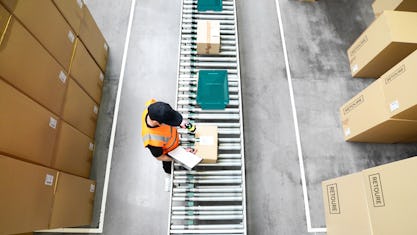
Returns management as the basis for business success
Returns can significantly reduce a company's profits. Therefore, it is important to avoid returns or to optimize them in terms of customer loyalty.
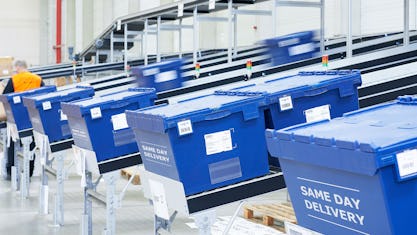
Will Same Day Delivery Become the New Standard?
Same day delivery could become a game changer for online business. However, the model is initially only interesting for city conurbations, certain customers and industries.