
How to Find the Right Logistics Partner
The right logistics partner combines operational efficiency with the right systems, clear responsibilities and a reliable working relationship. By defining your requirements before approaching providers, comparing potential partners against consistent criteria and carefully planning the implementation, you can minimise the risks associated with changing providers and create a solid foundation for future growth.
How do you find the right logistics partner?
Start by defining your processes, volumes, target markets, storage requirements and potential risks. Separate essential requirements from additional selection criteria, then evaluate providers against consistent standards covering performance, capacity, IT systems, quality, safety, costs and collaboration. Site visits, case studies, pilot projects and clearly defined service levels can help you make an informed decision, while a structured onboarding and exit plan will help ensure a smooth transition.
Define Your Requirements Before Searching for Providers
A successful selection process starts with a clear specification of your requirements. ISO and IAF guidance identifies defined selection criteria, risk-based controls and the ongoing monitoring of external providers as important elements of effective supplier management. ISO 9001 certification can demonstrate a provider's commitment to quality management, but it does not replace the need to clearly define the services your business requires.
Document the scope of services, product range, order and returns volumes, seasonal peaks, target markets, cut-off times, additional services, IT systems and relevant regulatory requirements. Involve the appropriate departments, including logistics, procurement, IT, quality and finance, as well as data protection or legal teams where necessary. All potential providers should work from the same volumes, assumptions and definitions to ensure their proposals can be compared fairly.
Separate Mandatory Requirements from Evaluation Criteria
Mandatory requirements are essential conditions that a provider must meet to be considered. These might include temperature-controlled storage, geographical coverage, specific IT interfaces or industry-specific certifications.
Once unsuitable providers have been excluded, the remaining candidates can be assessed using a weighted scoring system. Typical evaluation categories include operational performance, industry experience, scalability, IT capabilities, quality, total costs, risk management, network coverage and collaboration.
- Performance: Does the provider understand your products, processes, markets and specialist service requirements?
- Capacity: Have peak demand, staffing, technology and capacity for future growth been adequately considered?
- Operations: Are key performance indicators (KPIs), points of contact and escalation procedures clearly defined?
The Most Important Criteria When Choosing a Logistics Partner
Performance, Industry Experience and Scalability
A logistics service provider should be a good fit for your specific business model. Review case studies involving similar products, order profiles and target markets. Ask what performance levels they have achieved during peak periods, what additional capacity is available and how they manage short-term changes in demand.
The size of a provider alone says little about its suitability. What matters is whether its capabilities, experience and resources align with your operational requirements and future plans.
IT Systems, Data Quality and Transparency
Clarify how the provider's systems will integrate with your existing infrastructure, including ERP (Enterprise Resource Planning), WMS (Warehouse Management System), TMS (Transport Management System), online shops and marketplaces. You should also establish how master data, event notifications, reporting, technical support and system recovery procedures will be managed.
It's equally important to consider what happens if the partnership comes to an end. Find out how you will receive your order, inventory and historical data, and in what format.
If the provider processes personal data on your behalf, the responsibilities of each party must be clearly defined within the contract. According to the European Data Protection Board (EDPB), this includes following instructions, maintaining confidentiality and security, managing subcontractors, deleting or returning data and providing appropriate audit rights.
Quality, Safety and Compliance
Always check that certificates are valid and cover the relevant location and scope of services. Where additional security requirements apply, ISO 28000 can provide a cross-industry framework for managing security risks throughout the supply chain.
For shipments subject to EU customs regulations, Authorised Economic Operator (AEO) status may also be relevant. Depending on the authorisation, the European Commission links AEO status to requirements covering customs compliance, record-keeping, financial solvency, professional competence and security.
Cybersecurity risks can change throughout the course of a contract. The European Union Agency for Cybersecurity (ENISA) recommends identifying critical dependencies and single points of failure, regularly reviewing suppliers and including audit rights in contracts.
Look at Total Costs, Not Just Individual Prices
Compare quotes using the same baseline year, as well as realistic peak-demand and growth scenarios. Total costs should include equipment, IT interfaces, goods receipt, warehousing, picking and packing, packaging materials, shipping, returns, minimum order quantities, surcharges, reporting, internal resources and the potential cost of changing providers in the future.
A particularly low price may indicate missing cost items or a different interpretation of the services required. Looking at the total cost of the partnership will give you a more realistic picture of its long-term value.
Evaluate Providers and Manage the Partnership Contractually
Shortlist Providers, Arrange Site Visits and Consider a Pilot
When creating your shortlist, request comparable case studies, evidence of available capacity, relevant certificates, IT documentation and information about any subcontractors involved.
An on-site visit is an opportunity to see how the provider operates in practice. It allows you to assess whether its processes, warehouse technology, inventory management, safety measures and organisation match the information presented in its proposal. BITO's existing guidance also highlights the importance of established communication channels and a clearly defined point of contact.
For more complex projects, consider running a pilot using realistic data and operational scenarios. Test goods receipt, inventory reconciliation, picking and packing, labelling, tracking, returns and reporting. Agree on clear success criteria in advance so that everyone understands when the process is ready to move into full-scale operation.
Service Level Agreements (SLAs) and Exit Planning
Key performance indicators (KPIs), such as on-time dispatch, order and inventory accuracy, damage rates, returns processing times, system availability and response times, should all be clearly defined. Each metric needs an agreed calculation method, data source, measurement period, exclusions and target value.
The contract should also cover responsibilities, expected volume ranges, price adjustments, subcontractors, contingency planning, escalation procedures, termination arrangements, data return and the handover to a replacement provider.
Launch and Develop the Partnership in a Controlled Manner
A successful implementation requires clearly defined processes and responsibilities, thorough data and interface testing, a controlled inventory handover, a planned ramp-up and a stabilisation period.
During the initial ramp-up phase, regular operational reviews can help identify and resolve issues quickly. Once operations have stabilised, these should be followed by regular performance reviews and meetings to discuss future developments. Every agreed action should have a clearly assigned owner and deadline.
- Discuss any deviations using agreed performance data and work together to identify the underlying causes.
- Review capacity and potential risks when entering new markets, introducing new product lines or working with additional subcontractors.
- Test proposed improvements and incorporate them into standard procedures once their effectiveness has been demonstrated.
Which BITO Solutions Can Support Efficient Logistics Operations?
The efficiency of a logistics provider depends partly on the warehouse technology, material flow and availability of accurate data. BITO supports businesses with warehouse planning, intralogistics solutions, storage systems and digital intralogistics technologies.
The right solution depends on the individual requirements of each operation, including product characteristics, storage volumes, service commitments and system interfaces.
Adapting Your Logistics Partner Selection for International Markets
The principles of selecting a logistics partner can be applied across different countries and markets. However, local requirements must always be considered, particularly when it comes to data protection, customs procedures, transport and warehousing regulations, product safety, liability, insurance and the handling of hazardous materials.
AEO status is specifically referenced here as an example relevant to the European Union. For sustainability reporting, ISO 14083 provides a common methodology for quantifying and reporting greenhouse gas emissions arising from transport chain operations.
FAQ: Frequently Asked Questions
How many logistics service providers should you compare?
Start with a broad overview of the market before creating a shortlist of suitable candidates for a more detailed evaluation. There is no fixed number of providers you need to compare. What's more important is ensuring that every candidate receives the same information and is assessed against the same criteria.
Which KPIs should be included in a logistics SLA?
Typical logistics KPIs include on-time dispatch, order accuracy, inventory accuracy, damage rates, returns processing times, system availability and response times. Each metric should have a clearly defined measurement method and target to ensure performance can be monitored consistently.
Why is an on-site audit important when choosing a logistics provider?
An on-site audit allows you to check whether a provider's processes, capacity, technology, security measures and organisation match the information presented in its proposal. It can also reveal practical details that may not be immediately apparent, such as manual processes, how exceptions are handled and how effectively systems are used in day-to-day operations.

Process optimisation in warehouse logistics - How to increase your efficiency
Warehouse logistics is the centrepiece of a functioning supply chain. Especially in times of increasing customer demands and global competition, your commercial success depends heavily on how efficient your warehouse and shipping processes are.

Optimising the management of tenders
The use of tenders can unlock value creation potential and lead to an improvement in supplier relations. The challenge lies in standardising and digitising the processes.

How to lead projects to success
Almost every sixth company project fails. The reasons are manifold and include unclear goal definition, lack of resources, inadequate project planning and lack of qualified staff.

The importance of KPIs in logistics
Key Performance Indicators are quantifiable measurements used to monitor, analyse and control processes in logistics. They can also be used to help optimise processes.
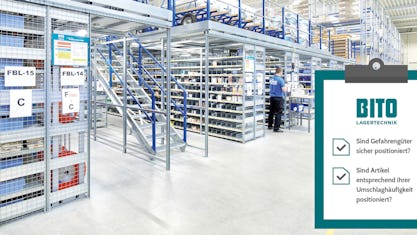
Checklist for storage equipment
Everything at a glance: Proper, professional and efficient storage is reflected in many guidelines and quality factors.