
Spare parts logistics in transition: How digital technologies reduce risk and stabilise supply chains
Spare parts logistics is changing rapidly. Rising supply chain disruptions, unpredictable demand and increasing storage costs are forcing companies to rethink how they manage spare parts availability. Traditional approaches based on high safety stocks and manual processes are no longer sufficient to guarantee uptime or service levels. Modern spare parts logistics focuses on resilience. By combining digital technologies such as IoT, artificial intelligence, automation and real-time visibility tools, companies can reduce risk, stabilise supply chains and ensure critical spare parts are available when they are needed.
What is spare parts logistics and why is it critical?
Spare parts logistics ensures the availability of components required to maintain, repair or operate equipment and machinery. It directly impacts production continuity, service performance and customer satisfaction. When spare parts are missing, the consequences include unplanned downtime, lost revenue and increased operational costs.
Because spare parts demand is often irregular and difficult to forecast, this area of logistics is particularly vulnerable to disruption. That is why many organisations are now investing in smarter, data-driven solutions.
Why traditional spare parts logistics creates risk
Many companies still manage spare parts using a “just in case” inventory strategy. Large stock levels are intended to protect against uncertainty, but they often create new problems instead.
Data is frequently fragmented between maintenance, purchasing, warehousing and service teams. As a result, organisations experience a paradox: warehouses are full, yet critical spare parts are unavailable. At the same time, excess inventory increases obsolescence risk, ties up capital and drives up storage and handling costs.
Resilient spare parts logistics requires a shift from reactive responses to proactive planning. This is where modern technologies play a central role.
How predictive maintenance improves spare parts availability
Predictive maintenance uses IoT sensors to monitor machine conditions such as temperature, vibration and energy consumption. AI-based analytics detect early warning signs of wear or failure.
For spare parts logistics, this means demand becomes predictable. Parts can be ordered, stored or positioned in advance, reducing emergency procurement and unplanned downtime. Predictive maintenance also supports lower safety stock levels, because spare parts are supplied based on real usage rather than assumptions.
How AI forecasting supports spare parts logistics
Artificial intelligence improves spare parts demand forecasting by analysing historical consumption data, equipment information, locations and external influencing factors. This is especially valuable for spare parts with intermittent or low-volume demand.
Better forecasts lead to higher parts availability with less excess inventory. Reorder points become more accurate, service levels stabilise and backorders decrease. To deliver real value, AI forecasts must be integrated into ERP and warehouse management systems so they trigger automated replenishment actions.
Why digital twins are becoming essential for spare parts
A digital twin is a virtual representation of a spare part created from CAD data or 3D scans. Digital spare parts libraries preserve technical knowledge even when parts are discontinued or suppliers change.
Digital twins reduce obsolescence risk and enable faster sourcing or manufacturing. They also allow companies to simulate different inventory and supply scenarios, supporting better decision-making across the spare parts lifecycle.
When additive manufacturing makes sense for spare parts
Additive manufacturing, commonly known as 3D printing, enables on-demand production of spare parts. Instead of storing physical inventory, companies store digital files and manufacture parts only when required.
This approach is particularly useful for rarely used, obsolete or hard-to-source spare parts. It reduces storage space, lowers capital commitment and provides an alternative supply option during disruptions. Not all parts are suitable for 3D printing, however, and material, strength and certification requirements must be carefully assessed.
How RFID increases transparency and trust
RFID technology enables automatic identification and tracking of spare parts and load carriers without manual scanning. It improves inventory accuracy, reduces search times and increases visibility across the warehouse and supply chain.
The role of control towers and warehouse automation
Supply chain control towers consolidate data from ERP, WMS, TMS, maintenance systems and external sources into a single real-time view. They provide early warnings of potential stock shortages or delivery delays and support faster, data-driven decisions.
Within the warehouse, automation plays a key role in reliable spare parts supply. Automated storage and picking systems reduce errors, increase throughput and deliver predictable performance, even when labour availability fluctuates.
Building resilient spare parts logistics systems
Modern spare parts logistics is not about adopting individual technologies in isolation. Resilience is achieved when predictive maintenance, AI forecasting, digital twins, RFID, control towers and warehouse automation are integrated into a connected system.
For companies looking to reduce risk, improve availability and stabilise supply chains, investing in data-driven spare parts logistics is becoming a strategic necessity rather than an option.

Possible applications of AI in logistics
Artificial intelligence is considered a key technology with far-reaching effects on the national economy and competitiveness. Areas of application for the technology include predictive logistics, smart warehouses and robotics.
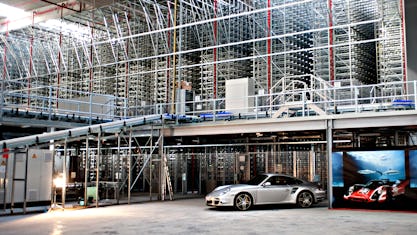
Spare parts logistics in the automotive industry
Spare parts logistics in the automotive industry is considered highly complex. Thousands of different parts for many different car models have to be provided just in time with the appropriate storage technology.