
How to optimise warehouse picking for Black Friday
To stay competitive during Black Friday and the following week, your warehouse operations must be scalable, efficient, and resilient. By combining smart picking strategies, modern WMS technology, AI-powered forecasting, and partial automation, businesses can handle the shopping frenzy with confidence.
Why does Black Friday Matter in Logistics?
For e-commerce and logistics operations, Black Friday Week is one of the highest sales periods of the year, generating a massive volume of orders in a very short time. As a result, warehouse and fulfilment teams must be fully prepared.
Your warehouse setup — including your pallet rack system, shelving height, and racking uprights — must support efficient, error-free operations. This is particularly important in fast-pick zones, where roller track systems or pallet live racking may be implemented to support live pallet racking workflows.
Black Friday began in the United States as a major retail event following Thanksgiving, traditionally marking the start of the holiday shopping season. Now, it has expanded globally, including in England and Ireland, stretching from the Monday before Black Friday to Cyber Monday.
How can I manage logistics pressure during Black Friday?
Like other high-volume sales periods, Black Friday Week places enormous strain on logistics and warehouse operations. Order surges stress picking, packing, delivery, and returns processes.
Asking yourself these questions can help you to start your optimisation process for Black Friday:
- How can order picking be made more efficient?
- Which warehouse systems can best handle e-commerce peak periods?
- What processes can be automated to scale operations?
How can order picking be optimised for peak periods?
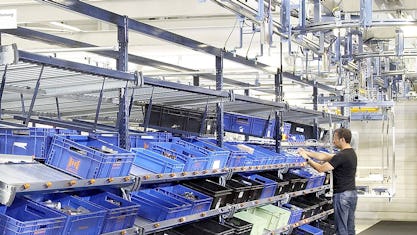
Manual warehouses scale with added labour and picking trolleys or shelf trolleys, but temporary staff can introduce errors due to limited training. For this reason, goods-to-person automation can reduce reliance on labour, while rack trolleys and roller track systems can boost ergonomics and throughput.
Ask yourself:
- How can order picking be made faster and more reliable?
- Which warehouse systems support e-commerce peak demand?
- What aspects of your operation can be automated or semi-automated?
The right combination of people, process, and racking equipment (such as cross bracing, column guards, and boltless rack systems) ensures safety, scalability, and speed.
Automated warehouse systems significantly improve performance during peak times. They offer:
- Faster order processing and increased throughput
- Lower error rates
- Scalable and ergonomic processes using the goods-to-person principle (as opposed to the labour-intensive man-to-goods method)
While full automation may not suit every e-commerce operation due to SKU diversity and order size, partial automation — using AMRs, cobots (collaborative robots), and automated guided vehicles (AGVs) — can dramatically enhance scalability and accuracy.
How can Warehouse Management Systems (WMS) help during Black Friday?
A modern WMS is essential for Black Friday success. It provides real-time inventory visibility and forms the basis for automated solutions, enabling:
- Chaotic storage and route optimization
- Lower error rates and improved reliability
- Fast data exchange and adaptive operations
- Integration across multiple sites or subsidiaries
- Operational adaptability
With AI integration, your WMS can predict volume spikes and recommend strategic use of buffer stock zones supported by mobile shelving or boltless shelving.
How to choose the right picking method for your warehouse
To optimise performance, minimize these picking time elements: base time, travel time, picking time, idle time, and distribution time.
In goods-to-man systems, which may have RFID transponder technology, explore these popular methods:
- Pick-by-light
- Pick-by-voice
- Pick-by-terminal
- Pick-by-MDE
- Pick-by-point®
Of these, pick-by-voice is particularly effective during high-volume periods. Voice-guided, paperless picking allows staff to work hands-free, focus fully on the task, and reduce errors.
For manual (man-to-goods) systems, fast-moving items should be stored near picking stations. Predictive inventory planning and WMS-driven optimization ensure:
- Inventory is organized by demand level and product class
- Route optimization is automatically applied
- Time-consuming searches are avoided
For semi-automated operations, flexible barriers and perforated panels can be used to define safe work areas around AMRs or AGVs. Combining smart zoning with shelving clips and adjustable shelving depth helps increase pick density in peak zones.
What is Single Stage Picking?
Single-stage picking is a picking method used for lower order volumes or simpler operations, tat picks entire orders at once, either sequentially or in parallel.
What is Two-Stage (Multi-Stage) Picking?
Two stage, or multi-stage picking in a picking method that is ideal for high order volumes with few items per order, common in e-commerce. Orders are grouped into batches based on item type, picked collectively, then sorted and packed afterward.
Advantages of two-stage picking:
- Fewer touchpoints per item
- Optimised travel distances
- Efficient for >1,000 orders with low SKU count
Two-stage picking is often paired with sorters and automated systems, which, while costly, offer high efficiency returns.
How to use AI-Powered Forecasting for Black Friday Planning
AI-based forecasting tools analyse historical sales data and seasonal patterns to predict demand and optimise stock levels.
Benefits of AI-driven warehouse planning:
- Accurate sales forecasting using past data
- Anticipation of seasonal trends
- Compensation for demand volatility
- High service levels through calculated safety stock
This ensures that your warehouse is well-prepared to meet peak season and Black Friday demand — without overstocking or underdelivering.

Christmas logistics: How to successfully master delivery bottlenecks and peak times
When order volumes explode in December and delivery bottlenecks loom, forward-looking Christmas logistics are key to keeping your customers happy. With clear processes, precise inventory planning, and a flexible peak season strategy, you can ensure stable supply chains, avoid out-of-stock risks, and reliably meet delivery guarantees.

Wearables offer super strength in the world of logistics
Wearables - computer technologies that can be worn on the body - are also revolutionizing the world of logistics. Data glasses, glove scanners, exoskeletons, etc. should make work easier and more ergonomic in the future.

How to avoid delivery delays through a good warehouse organization
If an ordered product does not arrive on time, it is always annoying - both for the customer and for the supplier.
10 errors you should avoid when picking
Everyone knows that for sure: Finally a long-awaited order arrives. Unpacked, looked at and then this: The article did not arrive as expected.