
Optimal use of space in the warehouse
Efficient use of space is crucial for the profitability of a warehouse. Through strategic planning and modern warehouse technologies, you can significantly increase your storage capacity without the need for additional floor space. The following eight core strategies show you how to get the most out of your available storage space.
Solutions for maximum space utilization in the warehouse
The right racking systems for optimum storage capacity
Compact pallet storage
More space with PDS, VPL and shuttle systems
In order to make efficient use of the available space, particularly compact systems are used for pallet storage.
PDS (pallet live storage), VPL (mobile pallet racking) and shuttle systems reduce the number of aisles and thus enable significantly more storage locations in the same space. They are ideal for companies with high stock turnover and limited space.
Design pallet racking for maximum height
Pallet racking can generally be planned in such a way that the maximum height of the warehouse is utilized - often up to approx. 17 meters, depending on the height of the warehouse and the technology used. In combination with narrow aisle solutions, the storage density can be increased even further - perfect for automated or semi-automated storage processes.
Efficient unit load storage for high space utilization
Multi-level racking systems for space expansion
Multi-level systems create additional storage levels on the same floor space. Each additional level almost doubles the storage space. Particularly in high warehouses , these systems allow the available space to be used optimally - whether for storage, order picking or packaging. Steel platforms also offer flexible application options here.
Dynamic systems such as SDS for compact unit load storage
The SDS system (Static-Dynamic Storage) stores items FIFO-compatible in the smallest of spaces - without additional walkways. The compact design enables particularly space-saving storage with high picking performance.
Clever double use of space: Combination of shelving systems
Another advantage lies in the combination: shelving racks (FBR) or SDS systems can be integrated into the lower level of a pallet rack. This reduces walking distances and saves space at the same time - an efficient solution for many applications.
Vertical space utilization with multi-level racking systems
The consistent use of room height
High-bay warehouse
Maximum use of space through vertical utilization
Regardless of the actual height, if you make full use of the available room height in the warehouse, you significantly increase the storage capacity on the same floor space. High-bay warehouses enable particularly dense storage - depending on the structural conditions and the storage and operating equipment used. The vertical alignment allows processes to be automated and large handling volumes to be managed efficiently - ideal for modern, efficient intralogistics.
Multi-storey racking systems for expanding space
Multi-storey systems make it possible to almost double the usable storage space per additional level - on the same footprint. Particularly in existing buildings, the available space can be ideally utilized. Steel platforms also offer an effective way of creating additional levels - for storage, order picking or packaging, for example.
These systems are particularly suitable for:
- Large product ranges with direct access to all unit loads
- Process-oriented storage (fast movers at the bottom, slow movers at the top)
- Simultaneous picking on several levels
Vertical racking for special applications
Vertical racking enables space-saving, upright storage of long goods such as profiles, pipes or chipboard. The standard heights range from 2,100 to 3,900 mm, making optimum use of the room height. The slight incline prevents the stored goods from tipping out.
Efficient storage layout for effective material flows
A well thought-out storage layout maximizes the use of space and speeds up work processes.
Flow principle for fast handling
Flow-through or FIFO racking ensures constant replenishment: as soon as a pallet is removed, the next one rolls in automatically. This increases handling rates and makes maximum use of the available space.
Suitable container systems for structured storage
Choosing the right container reduces empty spaces and creates order.
Stackable plastic containers for optimum storage structure
- Stackable Euro standard containers enable dense and structured storage.
- Optimal storage structure for high space utilization can be achieved with compatible container systems from various manufacturers.
- Food-safe versions are available for special sectors.
Individual containers for a wide range of variants
Tailor-made small parts containers minimize empty spaces and adapt flexibly to different article variants. This reduces space requirements and speeds up storage and retrieval processes.
Adaptation to article variants
Modular container solutions ensure that no space is wasted when storing a wide variety of items. Several container sizes and shapes can be optimally combined.
Dynamic systems for warehouse optimization through digital space analysis
Dynamic systems adapt ideally to your turnover rates and goods movements.
Flow and mobile racking for high turnover rates
- Flow racks based on the FIFO principle increase storage density by up to 60 percent.
- Mobile racking eliminates fixed aisles and creates up to 50 percent more storage locations on the same floor space.
- These space-saving shelving systems for warehouses adapt to changing goods movements and are ideal for high turnover rates.
Digitalization & analysis for continuous improvement
Modern software tools provide the data basis for continuous optimization.
Warehouse optimization through digital space analysis
Modern warehouse management software (WMS) records occupancy, vacancies and throughput times in real time. It shows:
- Optimization potential for shelf heights and aisle widths
- Most efficient storage space allocation based on item turnover and frequency
ABC analysis and KPI monitoring
- ABC analysis based on the Pareto principle places A goods (80% turnover, 20% stock) in quickly accessible areas.
- Key performance indicators such as stock utilization, pick performance and stock accuracy enable continuous fine-tuning.
Analysis-based planning for maximum warehouse utilization
Analyze article structure & turnover behavior
The basis for optimum space utilization is a precise analysis of your stored goods.
Which items are moved and how often? How large are the packaging units? Which storage zones make sense?
Our experts analyze these parameters on site and recommend the optimum racking combination based on this.
Individual racking combination instead of standard solution
It is often not a single storage system that offers the best solution - but a combination of different racking systems, tailored to your processes, article structure and structural conditions. As a full-service provider, BITO-Lagertechnik plans and implements your individual storage solution - from consultation to commissioning.
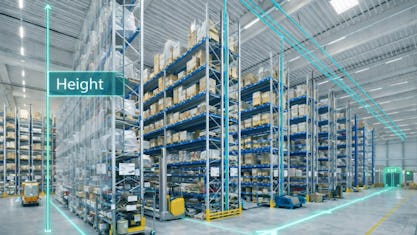
Hall height, fire protection, and floor requirements in warehouses – what you should consider when planning
When planning a warehouse, you should always consider hall height, fire protection, and floor requirements as an interconnected system. The height of stored goods directly influences the requirements for extinguishing technology and smoke extraction. Industrial floors must be able to withstand high point loads from racking systems – often, it is not the load-bearing capacity that is decisive, but the deformation under load. And the building geometry has an impact on fire protection concepts and technical building equipment. Early coordination of these factors creates planning security, speeds up approvals, and prevents costly retrofits.
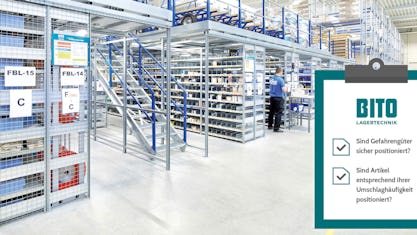
Checklist for storage equipment
Everything at a glance: Proper, professional and efficient storage is reflected in many guidelines and quality factors.