
Pick-by-Voice in the Warehouse: How Voice-Guided Order Picking Works
As order volumes increase and delivery times get shorter, efficient order picking is more important than ever. Pick-by-Voice guides warehouse employees through picking tasks using voice instructions, helping to reduce errors, improve productivity and keep both hands free. Find out how voice-guided picking works, its key benefits and where it can be used.
Pick-by-Voice: How Voice-Guided Order Picking Works and Its Benefits
Pick-by-Voice is a voice-guided order-picking method that gives warehouse employees instructions through a headset. Pickers confirm each task using voice commands, leaving both hands free to handle goods. By reducing the need for paper pick lists, scanners and screens, voice picking can help warehouses reduce picking errors, shorten search times, improve ergonomics and increase productivity. It is particularly useful in high-volume warehouses, including e-commerce, food and beverage, manufacturing and spare parts logistics.
What is Pick-by-Voice?
Pick-by-Voice, also known as voice picking, is a paperless order-picking system connected to a warehouse management system (WMS).
The WMS sends picking orders to the voice system in real time. The employee receives instructions through a headset, such as:
- Which storage location to visit
- Which product to pick
- How many items to pick
The employee then confirms each step verbally before receiving the next instruction.
Unlike traditional paper-based picking or scanner-assisted picking, there is no need to read a list or repeatedly operate a handheld device. This creates a continuous workflow and allows employees to keep their hands and attention on the picking task.
Modern voice systems can also support multiple languages and individual voice profiles, which can make them easier to introduce across diverse warehouse teams.
How does Pick-by-Voice work?
The process is straightforward:
- An order is created in the warehouse management system.
- The order is transferred automatically to the voice-picking system.
- The employee receives instructions through a headset.
- The employee travels to the required location and picks the specified quantity.
- The pick is confirmed by voice.
- The system verifies the response and sends the confirmation back to the WMS.
- The next instruction is provided, and the process continues until the order is complete.
Because employees do not need to stop and operate a scanner or read a paper list, they can focus on the goods and their surroundings throughout the process.
This can help reduce interruptions, improve workflow and make picking more ergonomic.
What are the benefits of Pick-by-Voice?
Voice-guided order picking can offer several benefits for warehouses handling large or complex order volumes.
- Hands-free picking
Employees can use both hands to handle products rather than holding a scanner or paper list. This is particularly useful when picking bulky, awkward or multiple items. - Fewer picking errors
The system provides clear instructions for the location, product and quantity, while verbal confirmation helps verify each picking step. - Faster picking
Employees receive their next instruction immediately after confirming the previous task. This can reduce unnecessary stops and search time. - Improved ergonomics
With no handheld scanner or paper list to operate, employees can concentrate on the physical picking task and maintain a more natural working position. - Faster employee training
Voice systems can guide employees through the picking process step by step. Modern systems can also support different languages and individual voice profiles. - Better process visibility
As the voice system communicates with the WMS in real time, picking activity can be recorded and monitored as part of the wider warehouse process.
Pick-by-Voice compared with other picking methods
There is no single picking method that is right for every warehouse. The best solution depends on factors such as order volumes, product ranges, warehouse layout and the level of automation required.
Pick-by-Voice is particularly effective where employees process many orders with different routes and need both hands free to pick products.
| Picking method | Key advantages | Potential limitations | Typical applications |
|---|---|---|---|
| Paper picking lists | Low investment cost | More errors and interruptions | Smaller warehouses |
| Scanner-assisted picking | Flexible and widely used | Employee must operate a scanner | General warehouse applications |
| Pick-by-Light | Very high picking throughput | Fixed locations | High-throughput picking zones |
| Pick-by-Voice | Hands-free, ergonomic and reliable | Headset and voice system required | Dynamic warehouses, e-commerce, manufacturing & food logistics |
How can voice control optimise warehouse processes?
Introducing voice picking is not simply a case of installing headsets and software. The technology needs to work alongside the warehouse layout, storage systems and existing processes.
Before implementing voice control, consider:
- Which warehouse processes would benefit most from voice guidance?
- Where are delays and errors currently occurring?
- Which areas would benefit from hands-free operation?
- How will the voice system integrate with the WMS and material flow?
- How will employees be introduced and trained on the new system?
A well-planned warehouse layout can make voice picking even more effective. Logical storage locations, short travel distances and ergonomic picking areas can all help reduce unnecessary movement and support a smoother flow of goods.
Which industries use Pick-by-Voice?
Voice-guided picking can be used across a wide range of industries where speed, accuracy and ergonomic working are important.
Typical applications include:
- E-commerce – high daily order volumes and fast fulfilment
- Food and beverage – including refrigerated and frozen warehouses
- Automotive and spare parts logistics – large product ranges and varying order requirements
- Pharmaceutical and healthcare logistics
- Wholesale – particularly where there is a wide variety of products
- Production supply and sequence picking
The greater the number of daily picking operations, the greater the potential benefit of a streamlined, voice-guided workflow.
When is Pick-by-Voice worth considering?
Pick-by-Voice can be particularly worthwhile when a warehouse:
- Processes a high number of customer orders every day
- Handles a large or varied product range
- Has significant costs associated with picking errors
- Regularly employs seasonal or new warehouse staff
- Needs to improve ergonomic working conditions
- Already operates with a warehouse management system
In these environments, reducing unnecessary movement, interruptions and errors can have a significant impact on the overall picking process.
Can Pick-by-Voice work with other warehouse technologies?
Yes. Pick-by-Voice can form part of a wider connected warehouse and can be combined with technologies such as:
- Barcode scanning
- RFID
- Pick-by-Light
- Pick-by-Vision
- Automated Guided Vehicles (AGVs)
- Autonomous Mobile Robots (AMRs)
- Conveyor technology
Integrating these technologies can help create more connected material flows and improve visibility across the order-picking process.
Pick-by-Voice as part of modern warehouse logistics
Pick-by-Voice can help warehouses create a faster, more hands-free approach to order picking. By connecting employees directly with the warehouse management system, the technology provides clear instructions while allowing them to concentrate on picking.
For warehouses with high order volumes, complex product ranges or demanding fulfilment requirements, voice-guided order picking can be an effective way to improve efficiency, accuracy and ergonomics.
The best results come when the technology is considered alongside the wider warehouse operation — including storage systems, layout, material flow and employee requirements.
What warehouse infrastructure is needed for Pick-by-Voice?
The effectiveness of a voice-picking system depends on more than the software. The warehouse itself needs to support efficient picking.
Depending on the application, this can include:
- Shelf racking
- Carton live flow racking
- Pallet racking
- Container storage systems
- Ergonomic picking stations
Well-organised storage locations and efficient material flows help employees find products quickly and reduce unnecessary travel.
For this reason, it is often beneficial to consider voice picking during the warehouse planning and design stage, rather than as a standalone technology. A warehouse designed around its material flow and picking requirements can provide a stronger foundation for efficient voice-guided operations.
FAQs about Pick-by-Voice
What is Pick-by-Voice in warehouse logistics?
Pick-by-Voice is a voice-guided order-picking method. Employees receive picking instructions through a headset and confirm each task using voice commands.
What is the difference between Pick-by-Voice and voice picking?
There is no significant difference. Pick-by-Voice and voice picking are commonly used to describe the same type of voice-guided order-picking process.
What are the main benefits of Pick-by-Voice?
The main benefits include hands-free operation, fewer picking errors, faster workflows, improved ergonomics and better process visibility.
Is Pick-by-Voice suitable for high-volume warehouses?
Yes. Pick-by-Voice is particularly suited to warehouses processing large numbers of orders, especially where employees need to follow different picking routes or handle a wide variety of products.
Can Pick-by-Voice integrate with a WMS?
Yes. Pick-by-Voice systems can connect with warehouse management systems and receive picking orders in real time, allowing completed tasks to be confirmed back to the WMS.
Which industries use Pick-by-Voice?
Common applications include e-commerce, food and beverage, automotive, spare parts, pharmaceutical and healthcare logistics, wholesale and production supply.

The future belongs to automation
Automated warehouse systems are becoming increasingly important in modern logistics. They enable companies to speed up processes, reduce error rates and reduce costs in the long term. But what exactly is behind them and what concrete advantages do they offer for the company's success?
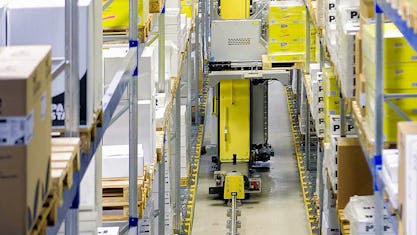
When does automation in the warehouse make sense?
With (partially) automated processes, warehouse efficiency can be increased, the error rate reduced and delivery times shortened. But when does automation pay off?

Digitization in intralogistics
Due to Industry 4.0, the digitization and automation of processes is increasing rapidly in intralogistics. FTS, warehouse management systems, cloud-based solutions, blockchain technology, etc. are on the advance.