
The last mile is decisive: How modern logistics is changing e-commerce
The last mile is the decisive factor for success in e-commerce – this is where customer satisfaction is determined. Rising parcel volumes, a shortage of skilled workers and high costs make innovative solutions and digital supply chain strategies indispensable.
What is the "last mile" in logistics?
Definition and challenges of the last mile
The "last mile" describes the final leg of a delivery, i.e. the transport of goods from the depot or distribution center to the customer. This phase is particularly cost-intensive and complex, as it has to take into account numerous individual factors such as traffic, delivery time windows and recipient availability.
The smaller and more diverse the orders, the more difficult it is to bundle them and deliver them efficiently. High personnel, time and transport costs arise, especially in the B2C sector with many private delivery addresses. Logistics companies and retailers are therefore working on new distribution concepts to make the last leg of delivery more efficient.
According to the PwC study " Setting out on the last mile”, 51% of consumers still prefer home delivery. 40% want deliveries within a specific time window, while only 20% prefer parcel shops. This shows that customer expectations remain high – and the last mile is at the center of competitive dynamics.
Last-mile logistics for e-commerce
Customer expectations and competitive pressure
In e-commerce in particular, everything has to happen quickly. Customers have been brought up to expect a high level of service, which they now demand. The battle for market share and sales in online retail is also being fought in the convenience sector. Buyers want same-day express delivery if possible, or at least to choose their own delivery time slot. As customers are very demanding, online retailers and platforms have to come up with some innovative solutions for the last mile. However, it is precisely this last leg of the delivery process that is particularly expensive and complex.
What is the role of supply chain management?
Supply chain management (SCM) aims to optimize the efficiency of the supply chain. In larger companies with complex supply chains, it is extremely important to coordinate the interactions between optimized inventory, delivery capability and capacity utilization via supply chain management. As a result, the delivery of goods can be planned precisely, and safety stocks can be reduced. Supply chain management therefore plays a crucial role in companies when it comes to on-time delivery, e.g. within delivery windows. The challenge and prerequisite are the digitalization and automation of supply chains and processes.
Concepts for the last mile
Pick-up stations, parcel boxes and smart delivery
In order to simplify delivery while reducing costs, time and CO₂ emissions, more and more new pick-up and delivery concepts are emerging to complement traditional doorstep delivery. These models make a decisive contribution to increasing the efficiency of last-mile logistics and relieving the burden on delivery networks.
Packing stations and lockers:
A key approach is to consolidate delivery to permanently installed collection points. DHL now operates over 6,000 packing stations in Germany, while Amazon has placed over 1,000 lockers in supermarkets, gas stations and shopping centers. These stations offer customers maximum flexibility, as they can collect their parcels regardless of delivery times. For delivery companies, this eliminates the need for multiple trips, saving time and resources.
Private parcel boxes:
More and more apartment buildings and residential complexes are opting for shared parcel boxes that can be used by multiple delivery services. This solution enables contactless delivery, even when no one is home, and significantly reduces the logistical effort per parcel. For single-family homes, there are increasingly smart parcel boxes with app connectivity that simplify receiving and shipping.
Smart delivery:
Digital technologies are opening up new ways of delivery. Systems such as the Key Home Kit allow secure delivery to the home, while in-car delivery places parcels directly in the boot of the vehicle. The delivery person receives a time-limited digital key via an app to gain access – monitored by camera and GPS. These solutions reduce misdeliveries, increase customer satisfaction and are an example of the integration of logistics and smart home technology.
Crowdsourcing approaches:
Another trend in last-mile logistics is crowd delivery. Platforms such as Dropfriends and Pickshare enable private individuals to act as temporary parcel collection points. Neighbors accept shipments or take on local deliveries – a community-based solution that relieves the delivery network and reduces emissions.
These new concepts show that the future of the last mile lies in flexibility, digitalization and cooperation. By combining different forms of delivery, delivery routes can be shortened, costs reduced and customer needs precisely met.
Click & Collect and Click & Drive as omnichannel strategies
With Click & Collect or Click & Drive, customers order online and pick up their goods within a selected time window. These models combine online retail and brick-and-mortar sales and are considered part of omnichannel marketing.
Autonomous delivery by drones and robots
- Drone deliveries are still hampered by legal restrictions but are being tested in pilot projects (e.g. DHL Parcelcopter, Amazon Prime Air).
- Autonomous delivery robots such as Hermes' Starship robot or Ford's humanoid Digit are increasingly taking on delivery tasks – efficiently, flexibly and emission-free.
Optimization of last-mile logistics
How are artificial intelligence and predictive logistics changing last-mile logistics?
The last mile can account for up to 50% of total supply chain costs – representing enormous potential for optimization. Artificial intelligence (AI) enables predictive logistics in this area:
- Routes are optimized in real time.
- Delivery time windows are calculated precisely.
- CO₂ emissions and traffic conditions are dynamically incorporated into planning.
AI-supported systems help to predict peak times, balance shipment volumes and distribute resources efficiently. This reduces costs, shortens delivery times and achieves sustainability goals.
Digitalization and automation in the supply chain
Digital supply chain management connects warehousing, transport and delivery into one smart unit. Flexible networks, automated warehouse tech and data integration boost productivity and make supply chains more resilient.
Companies that rely on technologies, collaborations and sustainable transport concepts secure decisive advantages – on the last mile and far beyond.
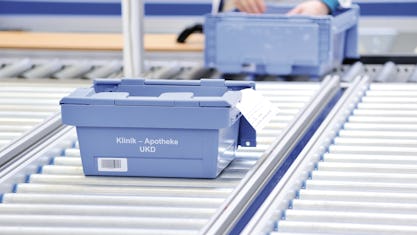
Container: Key position in material flow
Containers play a major role in the material flow. As load carriers and information transmitters, they are also very important for process optimization in the company.
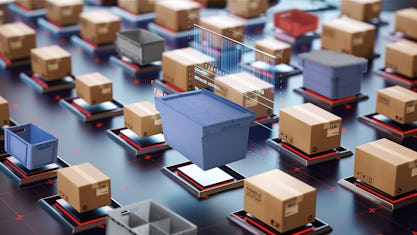
Blockchain in logistics
New blockchain solutions are developed almost daily. Small and medium-sized enterprises (SMEs) in particular should not miss the boat. The good news is that there are many ways to get started with this promising technology.