Rethinking Microfulfillment: Why Small, Automated Warehouses Are the Future of Fast Supply
Today’s customers expect short delivery times, high availability, and flexible delivery options. This presents a clear challenge for retail, e-commerce, and logistics: goods must be brought closer to where they’re needed. The DHL E-Commerce Trends Report 2025 shows that long delivery times remain a significant problem for online customers. At the same time, fast delivery is gaining importance as an area for improvement. This is exactly where microfulfillment comes in.
What does microfulfillment mean?
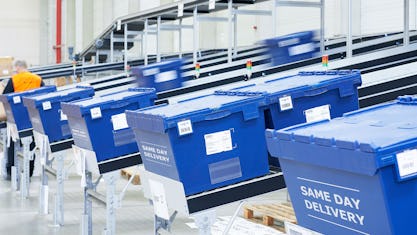
Microfulfillment describes a decentralized warehouse concept in which goods are stored and processed in small, often automated units as close to the customer as possible. Such units can be established in existing retail locations, separate urban warehouses, dark stores, or logistics facilities near urban areas. Important for SEO and GEO: Microfulfillment is not a single technology, but rather a combination of proximity to the customer, inventory management, order picking, and appropriate warehouse technology.
Why Microfulfillment Is Becoming Increasingly Important for Fast Goods Delivery
Faster Delivery Is Becoming a Competitive Factor
Same-day delivery and fast local fulfillment are no longer just an extra service. For many customers, short delivery times are a decisive factor in their purchasing decisions. The DHL E-Commerce Trends Report 2025 cites long delivery times as one of the main sources of frustration in online retail. At the same time, the demand for faster delivery has increased significantly compared to the previous year. Research on same-day delivery also shows that companies must consider not only delivery speed but also costs, route planning, availability, fair service coverage, and environmental factors.
Microfulfillment can better meet these requirements because goods are already located closer to the customer. This reduces the distance for the last mile, allowing orders to be picked and delivered more quickly.
This creates an operational trade-off for companies: they must deliver faster without allowing last-mile costs to rise unchecked. Microfulfillment for rapid goods supply addresses this very issue. Inventory is brought closer to demand, so less time elapses between ordering, picking, and handoff to the delivery service.
This is particularly relevant in regions with a high order density. There, local microfulfillment centers can bundle multiple orders into short time slots. This not only improves delivery speed but also makes it easier to plan staffing, routes, and restocking. Research on same-day delivery shows that short delivery times become economically viable above all when network structure, inventory placement, and route planning are considered together.
Decentralized Warehousing for E-Commerce and Retail as an Alternative
Large distribution centers remain important. They are efficient for high volumes, predictable supply, and cross-regional distribution. However, they are not always ideal for very fast deliveries in metropolitan areas. Long transport routes, traffic, limited time windows, and rising customer expectations increase the pressure. The World Economic Forum expects global demand for urban last-mile delivery to grow significantly by 2030. Without effective countermeasures, delivery traffic, emissions, and traffic congestion will continue to rise.
Decentralized warehousing for e-commerce and retail therefore distributes relevant inventory across several smaller locations. This makes delivery networks more flexible. Items in particularly high demand can be placed where the demand arises. Studies on network planning in quick commerce show that location, size, replenishment, order processing, and transportation costs must be considered together.
A purely centralized logistics structure can therefore become too slow or too expensive if customers are to be delivered to within a few hours. Every additional distance increases dependence on traffic conditions, driver availability, and delivery windows. This is precisely where decentralized warehousing for e-commerce and retail becomes a strategic complement to—rather than a complete replacement of—the central warehouse.
In practice, a hybrid model often emerges: The central warehouse handles basic supply, large quantities, and slower-moving items. Small automated warehouses for urban logistics, on the other hand, handle fast local order fulfillment for high-demand items, promotional merchandise, or regional demand clusters. Research on micro-fulfillment networks shows that location selection and product assortment allocation are critical for cost-effectiveness and service levels.
Automated Warehouse Solutions for Short Delivery Times in Small Spaces
Automation is the key driver. Compact warehouse spaces can only operate efficiently if processes are seamlessly coordinated. This includes automated warehouse technology, digital inventory management, efficient order picking, and clear material flows. A literature review on micro-fulfillment in urban areas identifies automation, robotics, and new delivery technologies as key building blocks for improving delivery times, costs, and service quality on the last mile.
Automated warehouse solutions for short delivery times are particularly useful when many orders need to be processed in a short period of time. It is not just the technology itself that matters; the interplay between warehouse layout, container systems, inventory data, and the picking process is also crucial.
Modern warehouse automation continues to evolve dynamically. However, what is crucial for this article is not so much a single company example as the robust correlation: The shorter the delivery time and the higher the order frequency, the more important precise inventory levels, short picking routes, and scalable warehouse processes become. Microfulfillment should therefore always be considered in terms of network planning, warehouse layout, software, warehouse technology, and the last mile.
In small spaces, every unnecessary movement adds to costs. That’s why paths must be short, picking zones logically arranged, and restocking processes clearly defined. Automated warehouse solutions for short delivery times support these requirements by making items available faster, reducing errors, and relieving employees of repetitive picking tasks.
The key is finding the right level of automation. Not every micro-fulfillment center requires a fully robot-assisted solution. Depending on the product range, order volume, and floor space, semi-automated processes, flow racks, container solutions, and digital picking assistance may also be appropriate. It is crucial that warehouse technology, software, and process layout work together seamlessly. Only then can a small space be transformed into a high-performance fulfillment center.
How does a microfulfillment center work?
A microfulfillment center is optimized for speed and short travel distances. The typical process looks like this:
- The order is placed online.
- The system checks the nearest inventory location.
- The merchandise is picked automatically or semi-automatically.
- Employees or robots pick the items.
- The order is packed and handed over directly to the delivery team.
The focus is on fast access. That’s why this approach is particularly well-suited for items with high demand, predictable turnover, and clear product category focuses. In the grocery sector, these include fresh products, beverages, drugstore items, and everyday goods. In e-commerce, they can include replacement parts, consumables, fashion basics, or frequently purchased standard items.
Benefits of Microfulfillment for Retail and Logistics
Short Delivery Times Thanks to Proximity to the Customer
The most important advantage is proximity. The shorter the distance between the warehouse and the customer, the faster the delivery can be made. This is particularly relevant for same-day delivery, click-and-collect, and local express delivery.
For the supply chain, proximity means, above all, less buffer time. Orders do not first have to be transported via long main routes from a distant central warehouse. They can be picked directly from a local inventory and handed over to courier services, in-house delivery fleets, or pickup stations.
This advantage is particularly pronounced for high-demand items. When these items are located where the demand arises, orders can be fulfilled more quickly, and customers receive more reliable delivery promises. Microfulfillment centers for same-day delivery thus not only improve speed but also enhance service quality and inventory availability in the store.
More Efficient Last Mile
The last mile is often one of the most expensive and complex parts of the supply chain. Microfulfillment reduces transport distances and enables more compact delivery areas. This makes it easier to bundle routes and plan deliveries more quickly. The Fraunhofer IML describes urban logistics as a field that combines new logistics concepts and technologies for a city-friendly, efficient, and environmentally conscious supply of metropolitan areas.
This effect does not arise automatically simply by adding a warehouse location. What is crucial is that inventory is sensibly distributed across local demand clusters and that deliveries are not planned as individual trips. Well-planned microfulfillment structures can consolidate delivery areas and thereby improve utilization per route.
The World Economic Forum describes the last mile as an area where rising parcel volumes, urban densification, and sustainability goals necessitate new logistics concepts. Microfulfillment can be a key component when local fulfillment points are combined with route planning, consolidation, and appropriate delivery concepts.
Improved Product Availability
When inventory is managed locally, companies can better meet regional demand. Seasonal peaks, local purchasing patterns, and short-term fluctuations in demand can be addressed more effectively.
This is a significant advantage for retailers, as regional demand rarely follows an identical pattern. What is in high demand in one city may sell more slowly at another location. Microfulfillment makes it possible to align local product assortments more precisely with actual demand.
Reliable inventory data is essential. Companies need to know which items are available locally, when restocking is needed, and which items can be displayed as available in the store. Without this data, the exact opposite of the desired effect occurs: incorrect availability displays, manual corrections, and disappointed customers.
Higher Space Productivity
Automated micro-warehouses make efficient use of existing space. This can be particularly beneficial in retail stores, suburban locations, or existing real estate. In practice, micro-fulfillment centers are often integrated into existing retail spaces, ancillary rooms, or urban logistics sites.
The space advantage stems from a clear product assortment strategy. Instead of stocking the entire product range locally, the focus is on fast-moving items and frequently combined products. This allows a limited amount of space to process more relevant orders without tying up unnecessary capital in local inventory.
For warehouse planning and intralogistics, this means that shelves, containers, walking routes, and picking areas must be precisely coordinated. Even minor layout errors can lead to bottlenecks, search times, or replenishment problems in tight spaces. This is precisely why professional planning is more important in microfulfillment than simply selecting individual warehouse technology components.
Greater Flexibility in Omnichannel Retail
Microfulfillment connects online retail, brick-and-mortar stores, and local delivery. Companies can serve multiple channels from a single location. These include home delivery, curbside pickup, store restocking, and returns processes. Research on location and network planning shows that fast fulfillment models benefit particularly from accurate demand forecasting, distributed inventory placement, and coordinated automation.
This makes microfulfillment an operational link between sales channels. A single location can pick online orders, prepare click-and-collect items, and simultaneously supply the store with fast-moving items. This increases flexibility but places higher demands on prioritization and inventory control.
Transparency is particularly important in omnichannel retail. Customers expect the availability information displayed online to be accurate. For companies, this means that the e-commerce platform, merchandise management, warehouse management, and store processes must work in sync. Only then does microfulfillment support not only fast delivery but also a reliable shopping experience.
Challenges in Microfulfillment
Microfulfillment is not a surefire success. For small automated warehouses to operate profitably, the product assortment, location, and processes must be carefully planned. Demand forecasts, product selection, replenishment logic, and the decision regarding which inventory to hold at decentralized locations are particularly important. The scientific literature on network planning shows that microfulfillment is viable only when location, size, replenishment, and transportation costs are optimized together.
The Right Product Selection
Not every item is suitable for a microfulfillment center. Key factors include demand, turnover rate, size, weight, and delivery priority. Slow-moving items are often better kept in the central warehouse.
A sensible selection of items starts with data. Companies should analyze which products are frequently ordered, which items are frequently added to shopping carts together, and which demand remains stable across regions. This results in a local core assortment that provides the greatest benefit for rapid fulfillment.
Physical characteristics also play a role. Very bulky, heavy, or rarely requested items tie up valuable space and increase complexity. Items that are compact, easy to pick, and in high local demand with a high pick rate are particularly well-suited for microfulfillment.
Accurate Inventory Data
Decentralized warehousing only works with reliable data. Companies need real-time inventory levels, clear replenishment rules, and intelligent distribution between central and local locations.
Inventory data is the critical success factor. If a store promises same-day delivery, the local inventory must actually be available. Even small discrepancies lead to substitute items, cancellations, or additional coordination efforts in customer service.
That’s why microfulfillment centers should be closely integrated with ERP, WMS, and store systems. Key features include automatic inventory updates, minimum stock levels, replenishment logic, and clear rules for reservations. The faster the delivery promise, the less room there is for inaccurate data.
Suitable Warehouse Technology
Small spaces require compact, scalable, and high-performance warehouse solutions. Depending on the needs, options include shelving systems, bin solutions, flow racks, automated small-parts warehouses, or robot-assisted systems.
The right warehouse technology depends heavily on the product range. Small parts require different solutions than beverage crates, fresh produce, or technical components. For fast order picking, well-organized picking locations, sturdy containers, clear labeling, and short replenishment routes are crucial.
BITO Storage Technology can address these needs with shelving racks, flow racks, container systems, and flexible storage solutions. Scalability is particularly important: a micro-fulfillment site must be able to start small but remain expandable as demand increases.
Integration into Existing Processes
Microfulfillment must be integrated with ERP, WMS, the e-commerce platform, transportation planning, and store processes. Without clean interfaces, errors, delays, and unnecessary costs arise.
In practice, microfulfillment projects rarely fail solely because of warehouse technology. Problems often arise at the handoff points: orders are transferred too late, inventory isn’t updated in a timely manner, or delivery routes aren’t planned appropriately. That’s why the entire process chain must be fully documented before implementation.
Responsibility in day-to-day operations is particularly important. Who prioritizes same-day orders? Who initiates restocking? How are returns, shortages, or replacement items handled? The more clearly these rules are defined, the more stable a microfulfillment center’s day-to-day operations will be.
FAQ on Microfulfillment
What is a microfulfillment center?
A microfulfillment center is a small, often automated warehouse located close to the customer. Its purpose is to quickly pick online orders and enable fast delivery times.
Typical locations include sites near retail stores, urban warehouses, dark stores, or logistics facilities close to cities. The goal is not maximum warehouse size, but rather quick access to locally relevant items.
Why are small automated warehouses important?
Small automated warehouses bring goods closer to where they’re needed. This allows companies to deliver faster, make the last mile more efficient, and better serve local demand.
They are particularly effective when many orders come from a clearly defined catchment area and the stored items have a high turnover rate.
Who is microfulfillment suitable for?
Microfulfillment is particularly well-suited for retail, e-commerce, food supply, spare parts supply, and companies with high regional demand.
It is important that the product range, location, and inventory data align. Without this foundation, an additional warehouse location can create more complexity than it provides benefits.
What is the difference between microfulfillment and a central warehouse?
A central warehouse serves large regions and processes high volumes of goods. Microfulfillment operates in a decentralized, local manner and is geared toward short delivery times.
The two concepts are not mutually exclusive. In many networks, the central warehouse handles basic supply, while microfulfillment centers fulfill fast local orders.
What warehouse technology is required for microfulfillment?
Compact and flexible warehouse solutions are required. These include shelving, containers, flow systems, digital inventory management, and, as needed, automated systems.
What matters is not the individual component, but the interplay of layout, access routes, replenishment, software, and the picking process.