
Lean Management in the Warehouse: How Hidden Waste Is Holding Back Your Efficiency
In many warehouses, efficiency losses aren’t caused by a single major problem. Often, they result from many small inefficiencies: search times, multiple handling, unclear storage locations, long walking distances, waiting times, or overcrowded areas. In day-to-day operations, these issues often seem normal. Taken together, they cost time, space, personnel, and productivity. This is exactly where lean management in the warehouse comes in. It makes waste visible and helps make warehouse processes leaner, more stable, and more efficient, step by step.
What does lean management in the warehouse mean?
Lean management in the warehouse means aligning all processes with value creation. Every step in the warehouse should have a clear benefit. Anything that consumes time, space, materials, or labor without improving the flow of goods is considered waste.
The goal is not to work faster at any cost. It’s about reducing unnecessary burdens and designing workflows so that employees, warehouse technology, and material flow work together optimally.
Where does waste occur in the warehouse?
Waste in the warehouse is rarely visible at first glance. An extra trip per order goes almost unnoticed. Two minutes of search time doesn’t seem like a big deal. A short wait at the packing station is quickly accepted.
The problem arises from repetition. When many employees make the same unnecessary trips every day, when goods are moved multiple times, or when follow-up questions constantly interrupt the workflow, high process costs result.
In lean practice, the eight types of waste are often considered. For warehouse logistics, transportation, inventory, motion, waiting time, defects, and unused employee knowledge are particularly relevant.
Unnecessary Transport and Multiple Handling
Every movement of goods costs time. The situation becomes particularly critical when items are moved between locations multiple times or when transfer points are poorly located.
A typical example: Goods arrive at the receiving area, are first placed in a staging area, later moved to the warehouse, then moved again for order picking, and finally transferred once more to the shipping area. Every additional process step increases the effort required and raises the risk of errors.
A lean approach therefore considers the entire flow of goods from receiving to shipping. The goals are short distances, clear transfer points, and a warehouse structure that aligns with the actual movement of items.
Search Times and Unnecessary Movements
It’s not just goods that move. Employees also cover a lot of ground every day. When frequently needed items are hard to reach, tools have to be searched for, or containers aren’t in the right place, unnecessary movements result.
Search times are particularly costly in order picking. Here, small delays quickly add up to many hours per week. Clear storage locations, unambiguous labeling, ergonomic reach zones, and sensible placement of fast-moving items can significantly reduce these losses.
Waiting Times and Bottlenecks
Waiting times occur when processes do not mesh smoothly. Examples include a lack of replenishment, blocked handoff areas, occupied packing stations, or unavailable means of transport.
Waiting times are often an indication that the material flow is unstable. In such cases, it is not enough to improve individual workstations in isolation. It is crucial to examine the interplay between goods receipt, storage, replenishment, order picking, packaging, and shipping.
Excessive Inventory and Blocked Space
High inventory levels provide a sense of security. At the same time, they tie up capital, occupy space, and make it difficult to maintain an overview. This leads to increased search times, error rates, and handling costs.
A lean warehouse structure is based on demand, turnover rate, and actual goods flow. Not every item needs to be located right next to the process. Fast-moving items belong in easily accessible areas. Slow-moving items can be stored farther away or in a more compact manner.
Errors and Rework
Incorrectly picked items, damaged goods, or unclear inventory data cause duplicate work. Errors must be identified, corrected, documented, and often reprocessed.
Clear labeling, appropriate containers, structured storage locations, and simple process standards help reduce sources of error in the warehouse.
How Can Lean Management Be Implemented in the Warehouse?
Lean management in the warehouse does not work through isolated measures. A structured approach to processes, material flow, warehouse technology, and employees is crucial.
Observe processes where they occur
The first step is direct observation on-site—not at a desk, but in the warehouse.
Helpful questions include:
- Where do search times occur?
- Which routes are traveled particularly frequently?
- Where are goods unnecessarily stored temporarily?
- Where do employees wait?
- Which areas are regularly overloaded?
- Where do errors or follow-up questions occur?
- Which processes are carried out differently depending on the shift?
Key metrics indicate that a problem exists. The process reveals where it originates.
Consider Material Flow and Warehouse Layout Together
Material flow should be as direct and seamless as possible. Every additional process step increases the effort required. Therefore, goods receipt, storage, order picking, packaging, and shipping should not be evaluated separately from one another.
Fraunhofer IML describes intralogistics and IT planning as a field in which warehouse planning, material flow, and modern logistics systems are considered together. For companies, this means that a good warehouse layout does not happen by chance. It must align with the product structure, order profiles, turnover rates, and process objectives.
BITO-Lagertechnik supports companies through consulting and planning to analyze product structures, material flows, and picking processes and to derive suitable warehouse solutions from them.
Organizing Storage Locations by Access Frequency
Not every item is needed with the same frequency. Fast-moving items should be easily accessible and located close to relevant process areas. Slow-moving items can be stored farther away or in a more compact manner.
This simple ABC-based approach can significantly reduce walking distances without requiring a complete redesign of the warehouse. It is important to review the placement regularly, as product structures, order quantities, and customer requirements change.
Establish Standards and Review Them Regularly
Lean management requires clear standards. They ensure that processes do not operate haphazardly but are reliably repeatable.
A practical method for this is the 5S method. It helps structure work areas, reduce unnecessary search times, and make order visible.
In the warehouse, for example, standards can define how putaway, replenishment, picking, packing, and handoff are carried out. It is crucial that these standards remain understandable, practical for everyday use, and up-to-date.
Actively Involve Employees
The best clues to waste in the warehouse often come from the people who work there every day. They know which routes are too long, which storage locations are impractical, and which processes regularly run into problems.
Involving employees not only improves process quality; it also increases acceptance of new procedures. Lean management in the warehouse works particularly well when improvement is not perceived as an external project, but as part of everyday work.
What role does warehouse technology play in lean management?
Lean management doesn’t work through methods alone. Warehouse technology must support the processes.
From BITO-Lagertechnik’s perspective, warehouse technology is “lean” when it provides clarity, reduces distances, simplifies material flows, and eases the workload for employees in their day-to-day tasks.
Shelving systems create clear warehouse structures
Racking systems create defined storage locations and provide a better overview. Product groups can be organized logically. Travel distances can be planned more efficiently.
Choosing the right racking system is particularly important. A warehouse for many small parts requires different structures than a pallet warehouse or a picking area with high access frequency.
Flow racks support the flow of goods
Flow racks for general merchandise support a continuous flow of goods. They are particularly suitable for fast- and medium-moving items and can facilitate FIFO processes.
By separating the loading and unloading sides, restocking and order picking can be organized more clearly. This reduces walking distances, improves visibility, and supports stable processes.
Container systems improve organization and handling
Container systems improve visibility, transport safety, and ergonomic handling. They help to neatly organize items and make processes more stable.
Especially in order picking, the right containers can help reduce search times, reaching distances, and errors.
Picking Solutions Reduce Search Effort
A good picking solution integrates storage location structure, item placement, and process logic. This reduces search times and error rates.
The more clearly the system guides employees through the process, the less room there is for improvisation, follow-up questions, and rework.
FAQ on Lean Management in the Warehouse
What is lean management in the warehouse?
Lean management in the warehouse means aligning warehouse processes with value creation and systematically reducing waste. The goals are shorter distances, fewer wait times, lower error rates, and a stable flow of materials.
How can lean management be implemented in the warehouse?
The first steps involve observing processes, analyzing the material flow, establishing clear storage location structures and standards, and actively involving employees.
How can warehouse processes be made more efficient with lean management?
Key measures include short distances, clearly defined storage locations, logical item placement, standardized processes, appropriate warehouse technology, and regular improvements.
Which Lean principles ensure greater efficiency in the warehouse?
Key Lean principles include value creation, flow, the pull principle, error prevention, and continuous improvement.
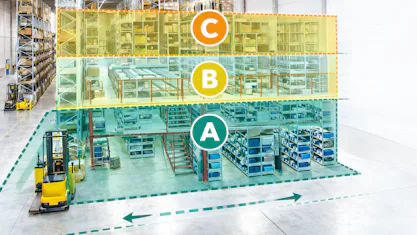
Influence of turnover rate and goods rotation on warehouse planning and management
How often is an item moved per year and what does that mean for your warehouse structure? Turnover rate and goods rotation are key indicators for economical warehouse planning. They influence layout, warehouse technology, inventories, and travel times. In this guide, you will learn how to use the right analysis to make your warehousing more efficient and optimize space utilization.

Process optimisation in warehouse logistics - How to increase your efficiency
Warehouse logistics is the centrepiece of a functioning supply chain. Especially in times of increasing customer demands and global competition, your commercial success depends heavily on how efficient your warehouse and shipping processes are.

Reduce walking distances in the warehouse - 5 ideas for quickly implementable measures
Speed and innovation are two decisive factors for companies when it comes to competing. This applies without exception to all sectors, but especially to those companies that have a logistics department. This is where the greatest potential lies to increase the efficiency and speed of work processes and thus bring an entire company forward.