
How to Find the Right Logistics Partner
A suitable logistics partner combines operational efficiency with the right storage systems, clear responsibilities, and a reliable partnership. By specifying requirements before issuing a request for proposals, evaluating providers based on the same criteria, and carefully preparing for the launch, you can reduce the risks associated with switching partners and create a solid foundation for growth.
How do you find the right logistics partner?
First, define processes, volumes, target markets, storage systems, and risks. Distinguish between non-negotiable must-have criteria and weighted selection criteria. Then evaluate performance, capacity, IT, quality, safety, costs, and collaboration using the same data set. On-site audits, case studies, pilot projects, measurable service levels, and a clear onboarding and exit plan will help ensure a sound decision.
Clarify Requirements Before Searching for Providers
A robust selection process begins with a statement of work. ISO and IAF identify defined selection criteria, risk-based controls, and the ongoing monitoring of external providers as core elements. ISO 9001 certification can demonstrate quality management, but it does not replace your own specification of the purchased service.
Document the scope of services, product structure, order and return volumes, seasonal peaks, target markets, cutoff times, required additional services, IT systems, and regulatory requirements. Involve logistics, procurement, IT, quality, finance, and, if necessary, privacy policy or legal departments. All candidates must base their calculations on the same volumes, assumptions, and definitions.
Separate Mandatory Criteria from Evaluation
Mandatory criteria are exclusionary conditions, such as temperature control, country coverage, a required interface, or industry-specific certifications. Suitable providers can then be compared using a pre-weighted scoring system. Typical categories include performance and industry fit, scalability, IT, quality, total cost, risk, network, and collaboration.
- Performance: Does the provider have a strong grasp of products, processes, markets, and specialized services?
- Capacity: Are peak capacity, staffing, technology, and growth reserves adequately accounted for?
- Operation: Are key performance indicators, points of contact, and escalation procedures clearly defined?
The Most Important Criteria for Logistics Partners
Performance, Industry Knowledge, and Scalability
Service providers must be a good fit for your specific business model. Review case studies involving similar products, order profiles, and target markets. Ask what performance levels have been achieved during actual peak periods, what capacity reserves are available, and how short-term changes are managed. The service provider's size alone says little about its suitability for your process.
IT, Data Quality, and Transparency
Clarify interfaces with ERP, WMS, TMS, online stores, and marketplaces, as well as master data, event notifications, reporting, support, and system recovery. The exit process is also important: In what format will you receive order, inventory, and historical data?
If the partner processes personal data on your behalf, the division of roles must be contractually defined. The EDPB lists, among other things, compliance with instructions, confidentiality, safety, subcontractors, deletion or return, and audit options.
Quality, Safety, and Compliance
Always verify certificates for validity, location, and scope. For heightened security requirements, ISO 28000 can serve as a cross-industry framework for security management with a supply chain focus. For EU shipments subject to customs regulations, AEO status may be relevant; depending on the authorization, the European Commission links it to requirements regarding customs compliance, record-keeping, solvency, competence, and safety.
Cyber risks evolve over the course of a contract. ENISA recommends identifying critical dependencies and single points of failure, regularly reevaluating suppliers, and including audit rights in contracts.
Total Costs Instead of Individual Prices
Compare quotes using the same base year as well as peak and growth scenarios. Total costs include equipment, interfaces, goods receipt, warehousing, picking and packing, packaging materials, shipping, returns, minimum order quantities, surcharges, reports, internal operations, and the cost of switching providers later. A conspicuously low price may indicate missing line items or a different understanding of the process.
Evaluate Providers and Manage Them Contractually
Shortlist, On-Site Audit, and Pilot
For the shortlist, request comparable case studies, proof of capacity, certificates, IT documentation, and information on subcontractors. An on-site visit reveals whether processes, warehouse technology, inventory management, safety, and organization align with the description in the proposal. The existing BITO framework also recommends established communication channels and a clear point of contact for this purpose.
For complex projects, a pilot should be conducted using realistic data and scenario-based exceptions. Test goods receipt, inventory reconciliation, picking and packing, labeling, tracking, returns, and reporting. Determine in advance when the process will be approved for ramp-up.
Service Level Agreement and Exit
Key performance indicators such as on-time shipping, order and inventory accuracy, damage rate, returns turnaround time, system availability, and response time require a formula, data source, measurement period, exclusions, and target value. The agreement should also address responsibilities, volume ranges, price changes, subcontractors, contingency planning, escalation, termination, data return, and handover to a successor.
Launch and Improve Collaboration in a Controlled Manner
An orderly launch includes defined processes and roles, data and interface testing, a controlled inventory handover, ramp-up, and stabilization. During the ramp-up phase, brief operational reviews are helpful; these should be followed by regular performance and development meetings. Actions must always have a designated person in charge and a deadline.
- Discuss deviations based on agreed-upon data and jointly identify the causes.
- Re-evaluate capacity and risks associated with new markets, product lines, or subcontractors.
- Test improvements and incorporate them into standard procedures only after their effectiveness has been proven.
Which BITO Solutions Make Sense to Integrate
Service providers can only operate as reliably as warehouse technology, material flow, and data availability allow. BITO provides support through warehouse planning, intralogistics solutions, warehousing solutions, and digital intralogistics. The selection is based on product structure, volume, service commitments, and interfaces.
Localizing the International Selection
This approach can be applied across national borders. The areas to be addressed include privacy policy, customs, transportation and warehousing laws, product safety, liability, insurance, and hazardous materials regulations. AEO is deliberately identified in the article as an EU example. For sustainability reports, ISO 14083 provides a common method for quantifying and reporting greenhouse gas emissions from supply chains.
FAQ: Frequently Asked Questions
How many logistics service providers should you compare?
Start with a broad market survey. For a detailed review, a short list of suitable candidates is sufficient. More important than a fixed number is ensuring that all providers receive the same data and are evaluated according to the same criteria.
Which metrics should be included in a logistics SLA?
Typical metrics include on-time shipping, order accuracy, inventory accuracy, damage rate, returns processing time, system availability, and response time. Each metric requires a clear measurement standard.
Why is an on-site audit important?
It shows whether processes, capacity, technology, security measures, and organization align with what is presented in the proposal. It also reveals manual handoffs, exception handling, and actual system usage.

Process optimisation in warehouse logistics - How to increase your efficiency
Warehouse logistics is the centrepiece of a functioning supply chain. Especially in times of increasing customer demands and global competition, your commercial success depends heavily on how efficient your warehouse and shipping processes are.

Optimising the management of tenders
The use of tenders can unlock value creation potential and lead to an improvement in supplier relations. The challenge lies in standardising and digitising the processes.

How to lead projects to success
Almost every sixth company project fails. The reasons are manifold and include unclear goal definition, lack of resources, inadequate project planning and lack of qualified staff.

The importance of KPIs in logistics
Key Performance Indicators are quantifiable measurements used to monitor, analyse and control processes in logistics. They can also be used to help optimise processes.
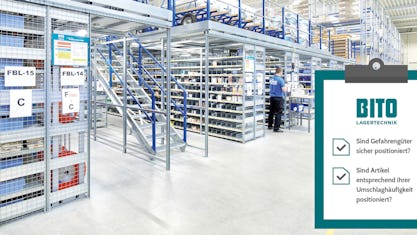
Checklist for storage equipment
Everything at a glance: Proper, professional and efficient storage is reflected in many guidelines and quality factors.