
How do automated shuttle systems increase efficiency in warehouses?
Same-day delivery, growing return rates, skilled labour shortages – logistics managers know the pressure. Traditional warehouse technology is reaching its limits, pallets are piling up, throughput times are getting longer, and every mistake costs valuable time. Automated shuttle systems open up a new dimension of efficiency here: they combine high-precision racking architecture with intelligent vehicle technology and transform warehouses into high-performance machines.
Fundamentals of shuttle systems in intralogistics
Automated shuttle systems consist of electrically powered vehicles (‘shuttles’) that independently store and retrieve pallets or containers within a specially designed racking system.
- Space efficiency: Multiple depth and multi-level storage double or quadruple storage capacity compared to traditional systems, as fewer aisles are required and more goods can be stored in the same space.
- Intelligent control: The shuttles run on rails integrated into the racking and communicate in real time with the Warehouse Control System (WCS).
- Process reliability: Every movement is automated, precise and without manual intervention – this reduces error rates and increases process reliability.
Practical insight: Performance does not depend solely on the shuttle, but on the interaction between the vehicle, racking technology and IT.
Increased efficiency in warehouses thanks to driverless shuttles
Quick storage and retrieval
Depending on the system design, a single shuttle can perform up to 1,500 movements per hour. Access to multi-depth storage locations minimises travel distances – a clear time advantage when order volumes are high.
Continuous 24/7 operation
Whether day, night or weekend: shuttles operate reliably around the clock. Autonomous charging cycles or battery changes prevent downtime – a solution that conserves valuable resources, especially in times of skilled labour shortages.
Racking systems that are designed for shuttle operation at an early stage ensure trouble-free and reliable operation. This prevents downtime and makes it easier to integrate different shuttle technologies. Close coordination between the racking manufacturer and system integrator is crucial to ensure that the mechanics and shuttles work together optimally.
Space utilisation and capacity gains
Intelligent densification instead of land expansion
In traditional warehouses, wide aisles waste valuable space – space that cannot be used for goods. Shuttle-based racking systems make consistent use of the available height and depth: multiple-depth storage locations, compact design and heights of up to 30 metres transform halls into high-density goods buffers. This significantly increases capacity without the need for additional land – a strategic advantage in view of scarce space and rising construction costs.
Flexible pallet storage as the basis for the system
- Multi-level storage increases storage density and reduces the number of access points required.
- Different pallet formats and heights can be flexibly integrated – ideal for dynamic product range structures.
- The shelving system forms the supporting infrastructure: mechanically precision-engineered, precisely tailored to the shuttle tracks and designed in such a way that subsequent expansions – additional shuttles, levels or entire aisles – can be added without interruption.
Digital networking for real-time transparency
- Standardised interfaces seamlessly link Shuttle WCS and warehouse management systems.
- Automatic inventory notifications, vacancy detection and real-time feedback ensure process stability and transparency.
- Monitoring tools make throughput and utilisation visible at all times and enable proactive optimisation.
Practical insight:
In a deep-freeze warehouse at –28 °C, driverless shuttles have replaced manual forklift logistics. The result: over 200 kWh of energy savings per day and a more stable cold chain thanks to faster storage and retrieval. The combination of robust racking architecture and highly automated vehicle technology creates a sustainable efficiency gain here.
Shuttle shelving systems for order picking automatio
Shuttle systems are not just warehouse robots – they also function as powerful buffer and staging systems for picking workstations.
Multi-shuttle configuration for high availabilityarkeit
- Several vehicles work in parallel in an aisle, minimising waiting times at picking stations.
- Dynamic load sharing ensures even utilisation and reliability.
Empirical value: Reliable picking automation requires high-performance shelving systems that are not only manufactured with mechanical precision, but can also be tailored to fit different shuttle vehicles in practice.
Transparency through dashboards and monitoring tools
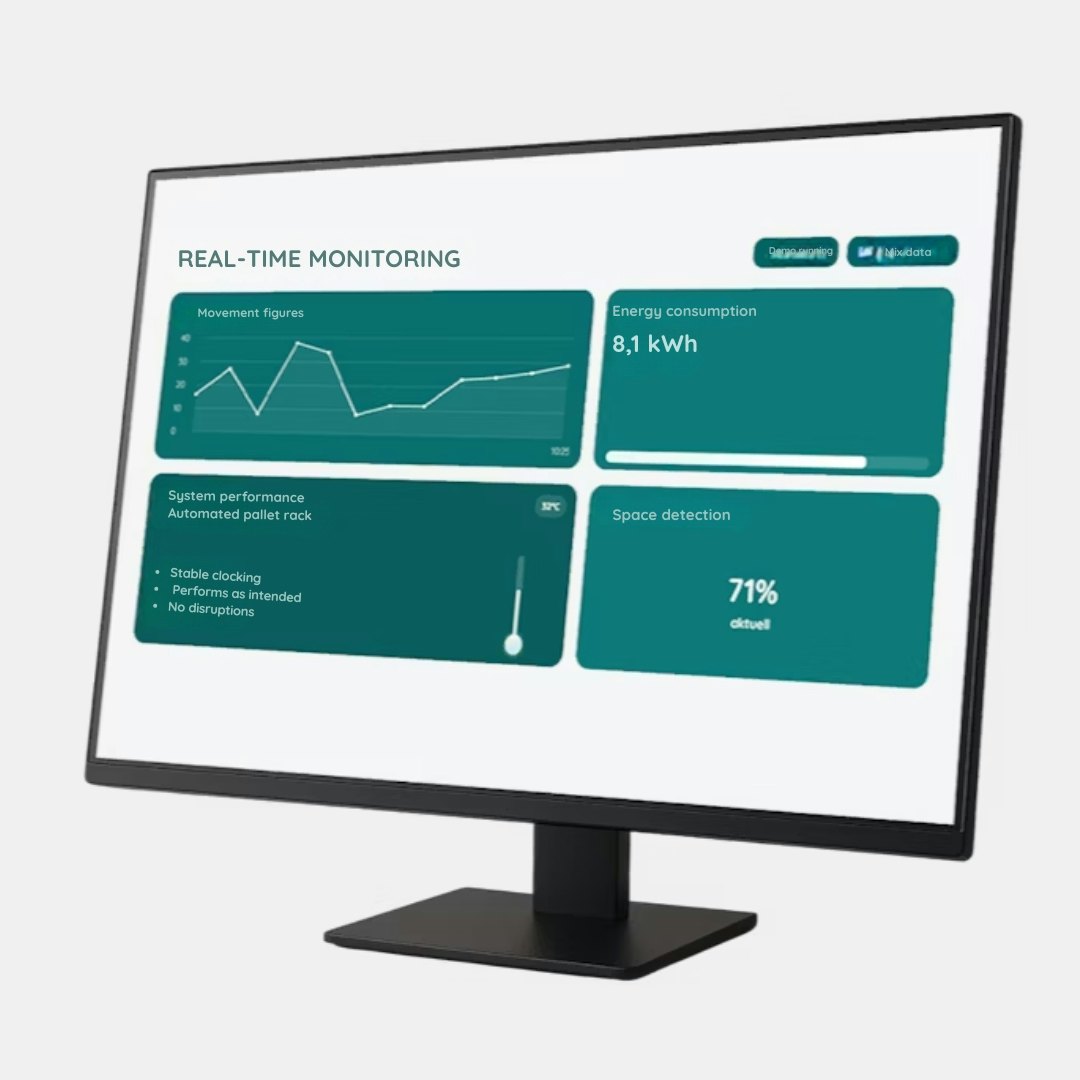
Modern shuttle systems offer not only physical efficiency but also digital transparency. Live dashboards and monitoring tools enable real-time monitoring of system performance – from movement figures and energy consumption to empty space detection.
- Visualised KPIs help to optimise throughput and utilisation.
- Alerts and predictive maintenance functions minimise unplanned downtime.
Particularly in highly dynamic environments such as e-commerce or fresh produce logistics, such tools are crucial for fine-tuning and responding quickly to process deviations.
Economic advantages and future prospects
Automated shuttle systems are not only powerful, but also demonstrate impressive economic benefits. They combine efficiency gains, scalability, error reduction and attractive payback periods – exactly what modern intralogistics needs.
Efficiency through consolidation and automation
Thanks to multiple-depth storage locations and compact shelving architecture, storage capacity is significantly increased while saving space. Automated processes reduce personnel costs, minimise error rates and enable uninterrupted operation 24 hours a day.
High scalability for flexible requirements
Shuttle systems can be adapted to seasonal fluctuations or growth in a modular fashion – by adding additional shuttles or lanes. This continuous expansion can be achieved without interrupting production.
Shorter payback period with high return on investment
Studies show that automation projects typically achieve a return on investment within 2 to 5 years – thanks to space efficiency, lower personnel costs and reduced error rates.
When selecting a shuttle solution, it is not only the technology that counts, but also the overall assessment. Strong partners such as BITO provide support in seamlessly integrating racking systems and shuttle systems. It is also important to keep an eye on the risks: oversized systems can tie up unnecessary capital, and shuttle technology can reach its flexibility limits with volatile product ranges. Sound advice prevents these pitfalls and ensures that the system fits in with the company's strategy – both now and in the long term.
Future outlook:
Shuttle systems are considered a key technology in modern intralogistics. In combination with AI, predictive maintenance and digitally networked supply chains, they will bring even greater transparency, speed and sustainability to warehouse logistics in the future.
Conclusion:
This opens up a wide range of possibilities for system integrators and end customers. The key is shelving technology that ensures shuttle compatibility and long-term expandability – the basis for efficient, future-proof solutions.